
“The Holy Grail”: DTB Systems Brings Smarter Communication to Healthcare Facilities

In ten years of working with healthcare facilities across the Midwest, Jerry Weiler has seen a lot of technologies come and go. But the VP of Business Development at DTB Systems says nothing has generated the kind of excitement he’s seen around a new communication tool his company is now bringing to the healthcare market.
“Out of the ten years I’ve been doing this, this is the holy grail for hospitals, clinics, and long-term care,” says Weiler. “It does everything they’ve been asking for, with built-in security. At the latest show, it would catch people’s eye from across the room and they would make a beeline for it. The response has been unbelievable.”
The tool generating all that buzz is the Walt Smart Radio, developed by Wichita-based technology company Weavix. DTB Systems — long known in the region as an authorized dealer and systems integrator for Jeron nurse call systems — has partnered with Weavix to build a custom integration that connects the Walt to a healthcare facility’s existing nurse call system. The result is a communication solution unlike anything currently available in the market.
Why the Old Tools Fell Short
For years, healthcare facilities have wrestled with how to keep nurses and frontline staff connected. Pagers could only receive a call. Two-way radios could receive and transmit, but the devices had a habit of disappearing. Smartphones brought more capability but came with their own headaches — apps that wouldn’t update, devices that drifted off the network, and security concerns. Enterprise communication systems like Vocera offered robust functionality, but at a price point few facilities could afford.
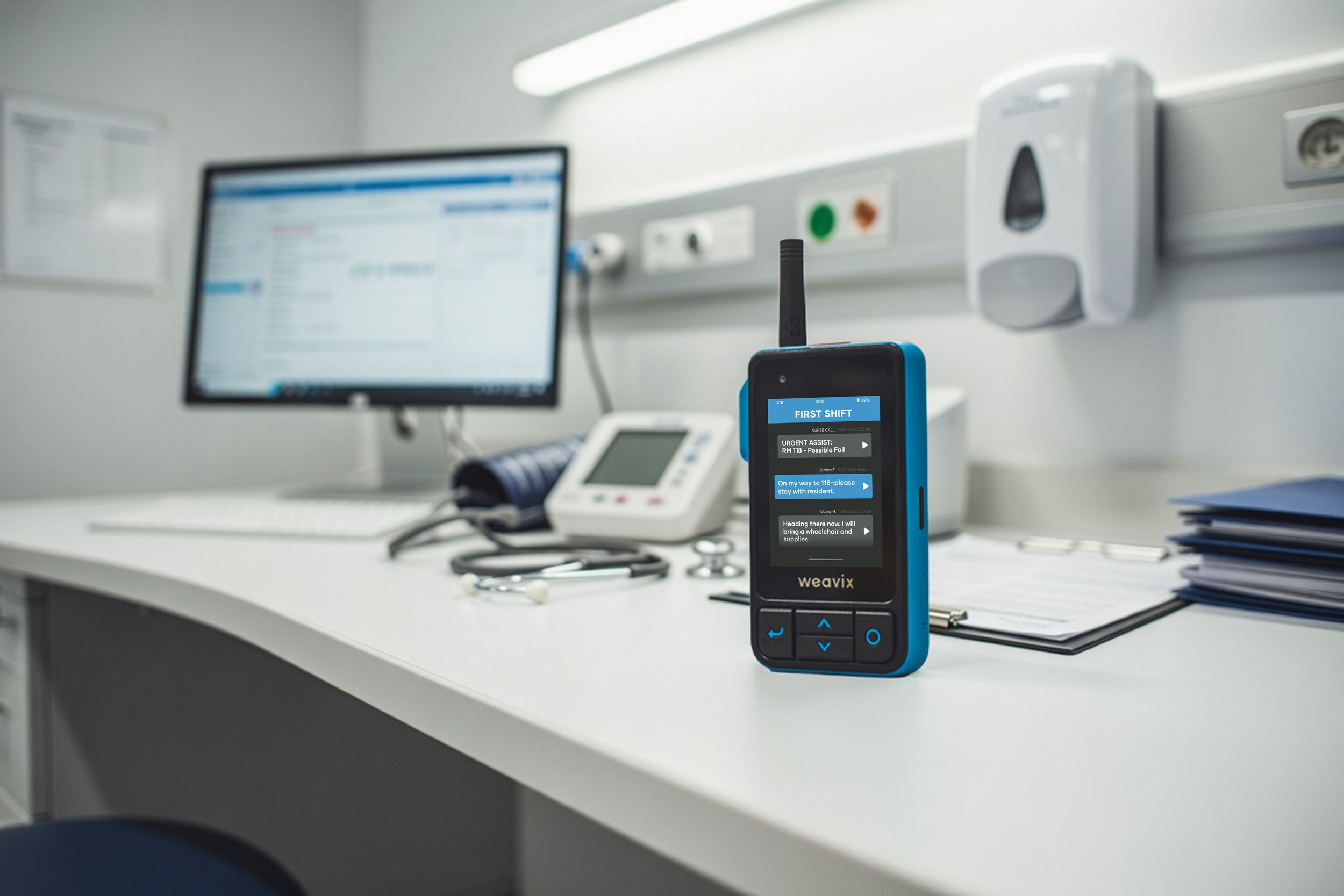
“In the past we’ve done pagers, two-way radios, smartphones — all of these can get the nurse call, but they all had certain inherent problems,” Weiler explains. “The Vocera thing costs $100,000, so not many people can afford to put it in.”
Ben Burrus, Chief Innovation Officer at Weavix, says this gap in frontline connectivity is bigger than most people realize. “Eighty percent of frontline workers don’t even have an email address,” he says. “Those of us sitting at desks have had opportunities for collaboration for years. If I have a problem, I can reach a colleague on Teams or send a quick email. But if you’re on your feet all day and you have a problem, you have to go find your supervisor — and that supervisor has to radio someone for help.”
Built Tough, Built Smart
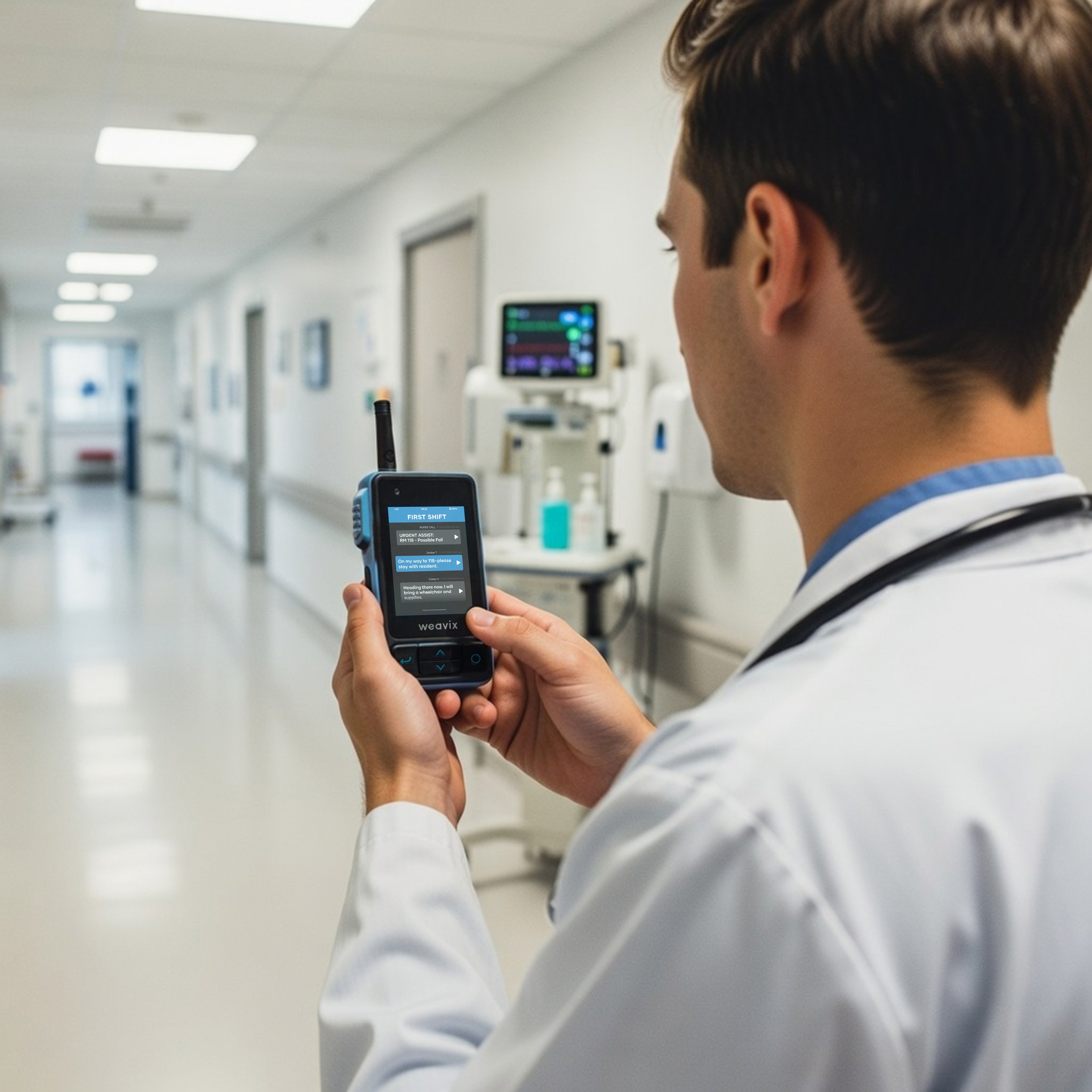
Weavix originally designed the Walt Smart Radio for the oil and gas industry, which is why it’s built the way it is — waterproof, drop-proof, and rugged enough for demanding industrial environments. When DTB Systems recognized its potential for healthcare, they developed the middleware integration that makes it work seamlessly with the Jeron nurse call systems they already install and service throughout the region.
“We want to connect every disconnected worker,” says Burrus. “Anyone that is on their feet all day — like nurses — needs the ability to come in, pick up any radio that’s ready to go, tap their employee badge to it, and it logs them in. At the end of the day, they dock it and it wipes it.”
One Device, Dozens of Solutions
The Walt does a lot, and Weiler says that’s almost the point. “Any one of these features by itself could make it pay for itself,” he says.
Authentication is seamless — a sticker on the nurse’s badge automatically logs them in when they pick up the radio, and the device logs them out automatically when it goes back on the charging dock. The radio charges in 60 minutes and provides six hours of battery life per shift.
Push-to-talk automatically transcribes voice messages to text, and the device can read messages aloud as well. Staff can send texts to one person, a small group, or broadcast to everyone currently logged in. Patient-initiated calls from bedside units or pull cords are routed directly to caregivers’ Walt devices via voice alerts, text notifications, or visual cues — eliminating overhead paging and reducing noise on the floor. GPS and geofencing mean devices no longer go missing — staff receive an alert reminding them to return the radio, and a “find me” feature works just like locating a lost cell phone.
One of the most compelling features for today’s healthcare environment is real-time language translation of some 15 different languages and multiple dialects. A message sent in English arrives in Spanish — or any other supported language — on the recipient’s end, automatically. “If a hospital is hiring a lot of non-English speakers, the translation feature alone is huge for them,” says Weiler.
Safety features include a dedicated SOS button, man-down detection, and digital mass emergency alerts. All calls and texts are captured in a searchable database, supporting HIPAA compliance, audits, and quality improvement efforts.
The Walt also works across multiple network types simultaneously — Wi-Fi, LTE cellular, and its own built-in mesh network that allows radios to communicate directly with each other even in an emergency or disaster scenario when other networks are down. Managers and supervisors can access all the same features on a smartphone app or desktop computer.
DTB’s Role: The Integration That Makes It Work
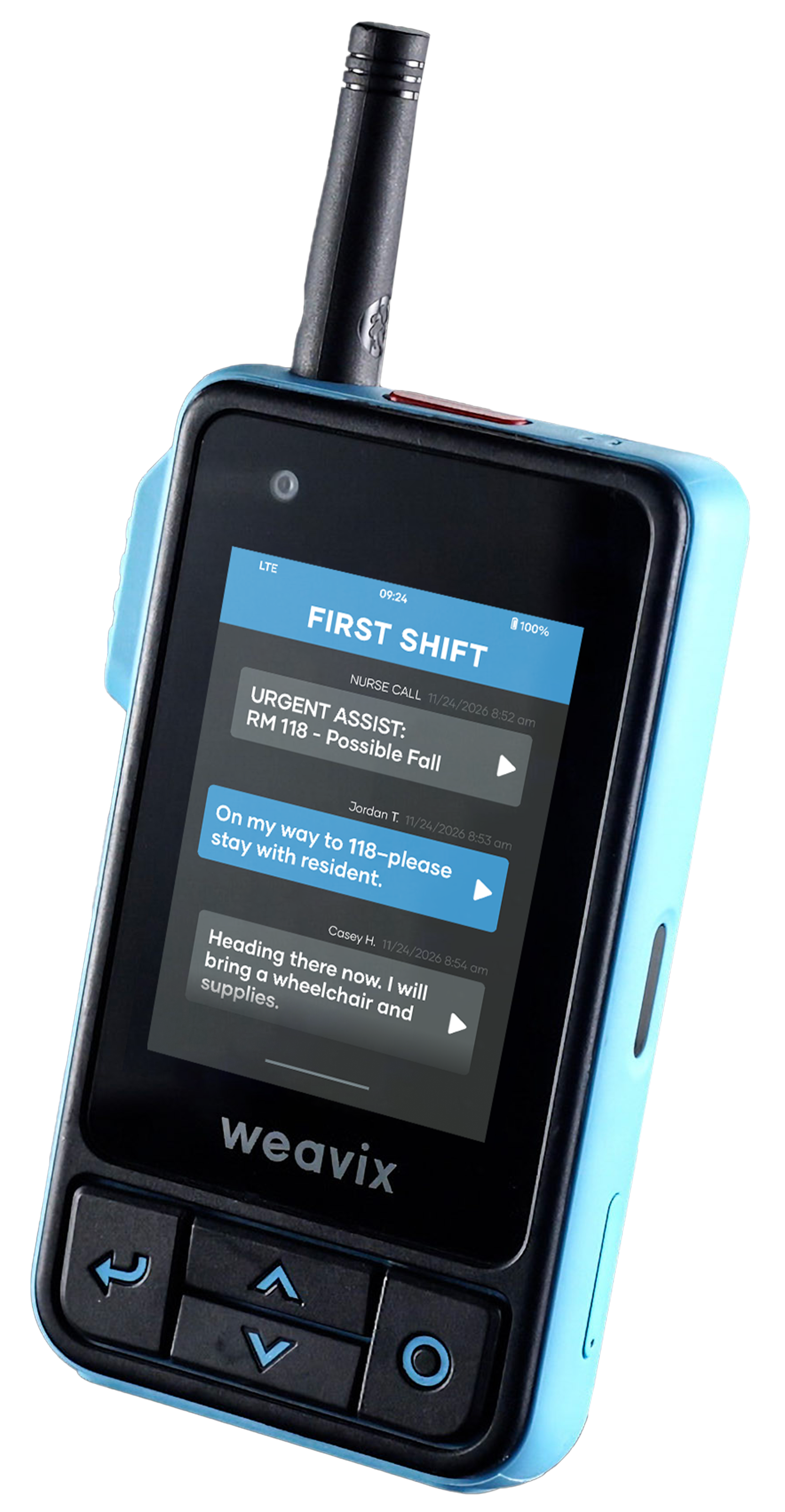
What sets this solution apart is the middleware DTB built to connect the Walt Smart Radio directly to a facility’s Jeron nurse call system. That integration is DTB’s specialty — and it’s what transforms the Walt from a powerful standalone communication tool into a fully embedded part of a facility’s care delivery infrastructure.
Under this partnership, the support responsibilities are clearly defined. Weavix sells and supports the Walt radios directly, while DTB owns the integration layer and continues to install and service the nurse call system. Healthcare facilities benefit from dedicated expertise on both sides — the people who built the radio supporting the radio, and the
people who built the integration supporting the integration.
“The radios are covered, the nurse call system is covered,” says Weiler. “The institution figures out how many devices they’re going to need, and we handle the rest.”
Burrus sees the healthcare setting as a natural fit for the platform. “The dispatcher can see where everyone is. They can see the response time. They can spot inefficiencies to improve patient experience,” he says. “We believe that 99 percent of workers want to come to work and do a good job. This gives management an opportunity to spot inefficiencies and streamline processes.”
Coming to Healthcare Near You
DTB’s first Walt installation in a healthcare setting is currently underway at a large long-term care facility in North Dakota — and Weiler says that’s just the beginning. He sees the technology as especially well-suited to the kinds of facilities DTB has always served best: critical access hospitals, long-term care, and rural health systems that need rock-solid reliability without enterprise-level price tags.
As for what comes next, Burrus has a clear vision. “They all have this digital hub on their person. Now, how can we use this to improve patient care?”
For healthcare facilities interested in learning more about the Walt Smart Radio and DTB’s nurse call integration, contact DTB Systems to schedule a personal demo or quote at info@dtbsystems.com or call (605) 335-4397.