
Avera St. Benedict Leads Global Pilot of New Rural Trauma Team Development
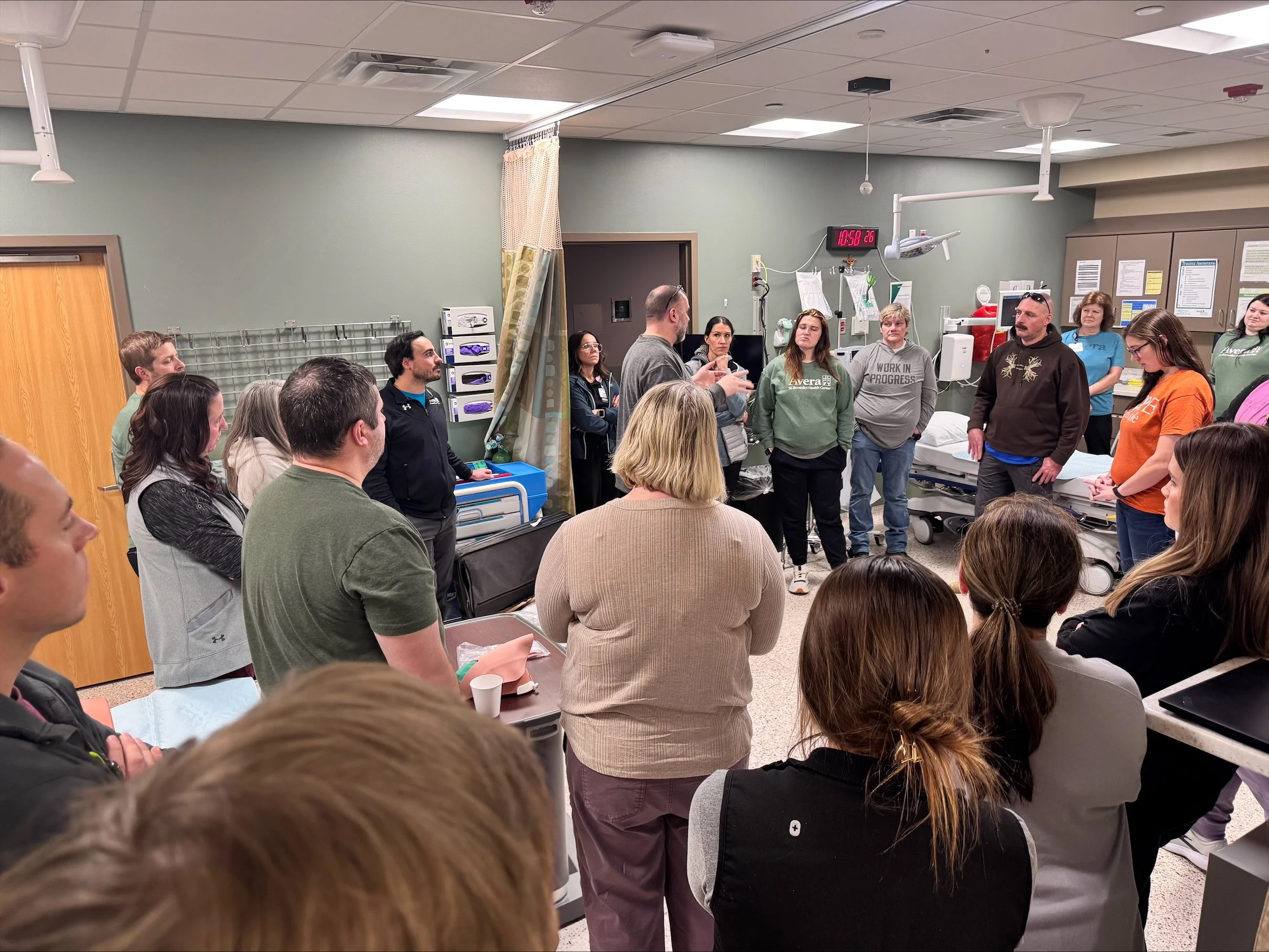
Avera St. Benedict Hospital has made history as the first site in the world to receive and pilot the newly updated Rural Trauma Team Development Course (RTTDC), an internationally recognized program to strengthen trauma response in rural areas.
“This was a great opportunity for us to collaborate with our multidisciplinary team at Avera St. Benedict,” said Lindsay Weber, CEO at Avera St. Benedict. “The updated curriculum provides methods to help our trauma team ensure high quality trauma care in a rural facility.”
The training, held on February 4, covered subjects on airway, breathing, circulation, disability and more. It involved a multidisciplinary care team, essentially anyone who would participate in the care of a trauma patient. That included local EMS, nursing staff, providers, CRNAs, respiratory therapy, radiology, lab and others. Actual patient cases were reviewed for performance improvement, which the attendees found incredibly valuable.
“The RTTDC and its principals are imperative for our team as it is the core of how we prepare and care for our injured patients. It was a great day to strengthen our shared mental model when critical patients hit the doors,” said Erin Denning, Trauma Coordinator at Avera St. Benedict. “I am grateful for the RTTDC team for bringing the education to us, and I am thankful for the amazing attendance from our EMS crew and staff.”
The RTTDC participants comprised 4 physicians, 6 emergency medical technicians, 3 advanced practice providers and twenty-four nursing and ancillary staff. They worked through several RTTDC updates, including:
Updated trauma team roles and communication models:
The new edition places stronger emphasis on rapid role assignment, closed‑loop communication and streamlined activation processes.Revised initial assessment and stabilization workflows:
Reviewed updated content around the primary and secondary survey, early recognition of high‑risk trauma patients and improved strategies for rural facilities to initiate stabilization prior to transfer.Hands‑on, scenario‑based simulations:
The new course design includes more immersive case simulations tailored specifically for rural resources and constraints.Enhanced interfacility transfer planning:
The updated materials walk teams through improved coordination with emergency management partners, communication expectations and steps to optimize time‑to‑transfer for trauma patients.Focus on rural‑specific strengths and barriers:
The curriculum now highlights strategies for maximizing small‑team efficiency, leveraging cross‑trained staff and addressing rural challenges such as limited specialty coverage.
“Throughout the training, we were able to repeatedly practice real life trauma scenarios,” said Brittany Olson, RN, Director of Patient Care Services at Avera St. Benedict. “It’s an honor to contribute to a course that will ultimately strengthen trauma response in rural communities around the world.”
Drs. Michael Person and Michael Brozik, both from the Surgical Institute of South Dakota, provided chest tube insertion and other lecture training with providers. Erin Beck, RN, nurse educator from Avera McKennan, led nursing education on chest tube insertion, including the nursing role in assisting and setting up for the patient. She also set up a skills station for intraosseous access practice.