
Where Expertise & Education Meet
The Sanford Center for Digestive Health
By Alex Strauss

Left to Right - Dr. Jeffrey Murray and Dr. Jorge Gilbert
For Dr. Jeffrey Murray, the opening of the new Sanford Center for Digestive Health represents the culmination of a decade-long vision—one that promises to transform digestive healthcare across the Dakotas and beyond. As he talks us through the details of the state-of-the-art facility occupying the top floor of Medical Building 1 on the Sanford USD Medical Center campus in Sioux Falls, his enthusiasm is contagious.
"This is going to be a game-changer for our region," says Dr. Murray, who has served the Sioux Falls community as a gastroenterologist for 37 years. "We will be training future gastroenterologists right here in Sioux Falls. It's a huge step in establishing Sanford Health as the destination for gastroenterology care as we become the premier rural health system in the country."
Meeting a Critical Need
The timing couldn't be more crucial. According to Dr. Jorge Gilbert, who has practiced alongside Murray for 23 years, the need for specialized digestive healthcare is rising dramatically—particularly among younger patients. "Data and studies have shown that even though the rate of colon cancer has decreased in the last 25 years, there is a gigantic increase in the number and mortality of colon cancers in younger people," Gilbert explains.
Murray underscores this point with a sobering statistic: "The number one cancer death in men under age 50 is colon cancer," he says. "When you think of that stat, it's truly daunting. And it's the number two cancer killer in women. This underscores the need for screening these individuals between 45 and 49."
This troubling trend, combined with the U.S. Preventive Services Task Force's 2021 decision to lower the recommended screening age for colon cancer from 50 to 45, has created what Murray calls "a perfect storm." The change added 19 million Americans to the screening pool, bringing the total number needing screening to 60 million right now. Yet by 2025, the nation is predicted to have a shortage of 1,600 gastroenterologists.
The center's team is working to close significant gaps in preventive care. "Any screening program aims to reach about 80 percent of the population," Dr. Gilbert explains. "We are in the 60s right now." With the new facility's increased capacity—averaging as many as 80 to 90 procedures a day—the team is better positioned to meet these ambitious screening targets and improve community health outcomes.
A Center Designed by Physicians, for Patients
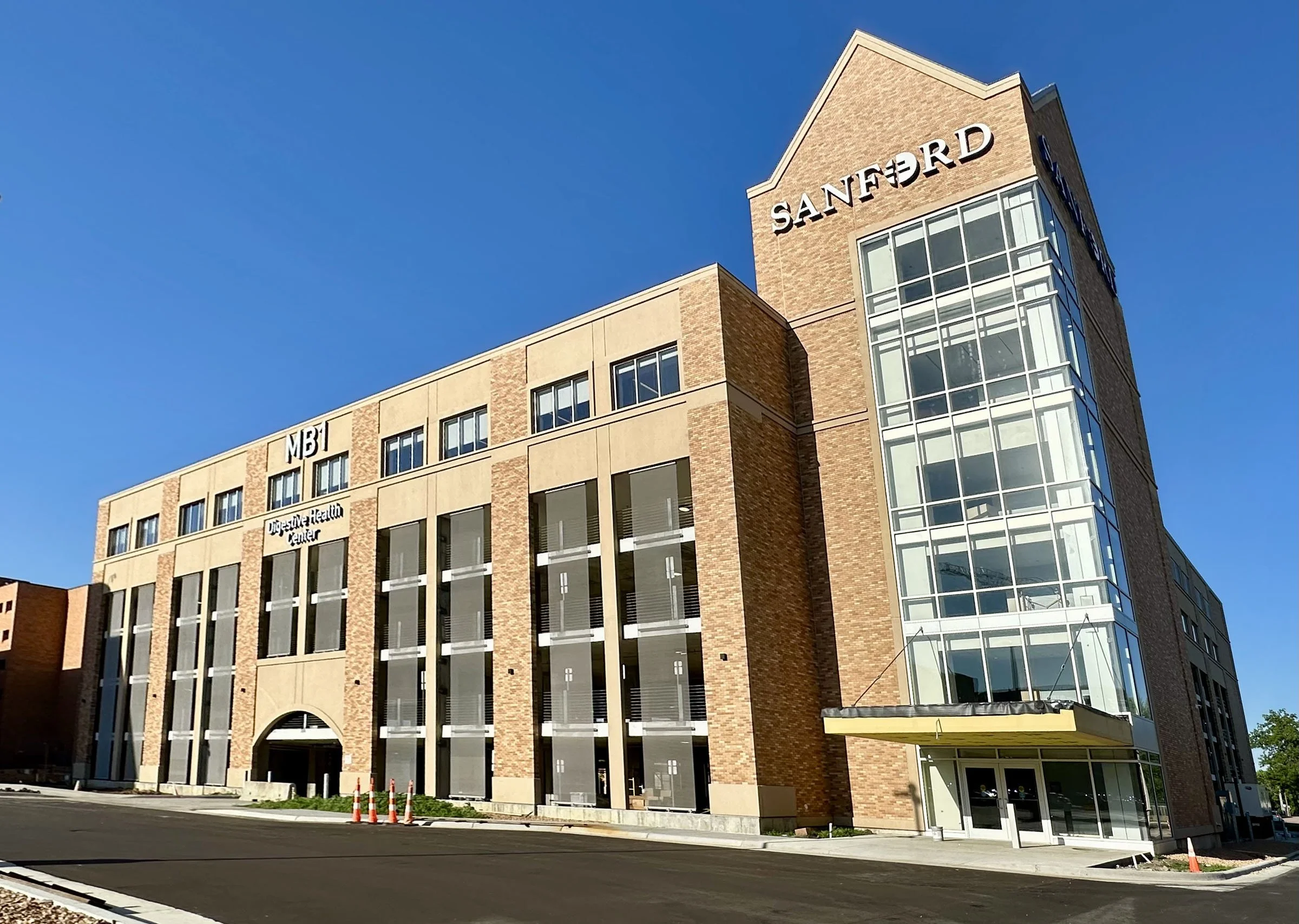
The new 45,000-square-foot Sanford Center for Digestive Health represents a thoughtful response to these challenges. Both Murray and Gilbert played integral roles in its design, creating a space that prioritizes patient experience and clinical efficiency.
"One of the great things about the new center is that we go to help plan and design it," says Murray. "The patient flow has been well-orchestrated and patients say they love the new space and the new building. They can tell that the staff are excited to be here. It's a fresh new start in the field of gastroenterology."
The center features ten procedure rooms, with eight currently functioning and two more opening soon. The facility includes 39 exam rooms, 40 pre- and post-operative rooms, and space for 30 physicians. Perhaps most importantly, it combines clinic and procedural spaces on the same floor—a design choice that Gilbert says makes a significant difference in patient care.
"It provides nice continuity and is practical for our patients," Gilbert notes. "Sometimes we find that we have to make a hard diagnosis when we finish an endoscopy. It's so good to have the entire gamut of GI care right next to us—we can make a collegial and strategic plan of care right on the same site."
Gilbert says the set-up also makes it possible for advanced practice providers to deliver the highest level of care by making it easier for them to ask a question or collaborate with a physician, even if they are performing a procedure.
The new facility's strategic design extends beyond clinic and procedure spaces. Housed within the newly constructed Medical Building 1, the center benefits from the integrated 400-space parking deck that makes up the first four floors of the building. Onsite parking ensures convenient access for both patients and staff, while the structure itself was built with future growth in mind—capable of accommodating three additional levels above its current five stories.
Building Excellence Through Education
The crown jewel of the new center is its fellowship program—the first accredited gastroenterology fellowship in the Dakotas. Starting in July 2025, the three-year program builds upon Sanford's established reputation in medical education. Two new fellows will be accepted each year and will be trained through a comprehensive curriculum in an environment equipped with the latest technology.
"In this new building we have the advantage of having state-of-the-art equipment," Murray explains. "We have AI endoscopy technology in at least two of the procedure rooms, which will be important for trainees as they learn procedures." The center also features a simulator to help fellows master endoscopic procedures—one of many requirements for accreditation by the Accreditation Council for Graduate Medical Education (ACGME).
"It's important to realize that we are not teaching students here. We are teaching physicians who are already internists to become subspecialists in the field of gastroenterology and hepatology," says Gilbert. "That requires that we teach at the very highest level we possibly can, which also serves to make us better doctors."
A Comprehensive Approach to Care
The Center for Digestive Health currently employs 15 gastroenterologists and 12 advanced practice providers, offering comprehensive care for a wide range of digestive health conditions. Gilbert points out that the team has begun to subspecialize, with dedicated experts for liver diseases, complex biliary procedures, and acute inpatient care.
The center stands as the region's most experienced digestive health team, earning distinction as the only hospital-based ASGE Recognized GI Lab in South Dakota. The team provides specialized care spanning the full range of digestive disorders—from common conditions like acid reflux and celiac disease to complex pancreatic and liver disorders.
"We have expanded not only in the number of physicians but also in expertise," he says. "We now have eight general gastroenterologists, two doctors that are liver-only, one (soon to be two) who do complex advanced biliary procedures to diagnose diseases of the biliary tree and pancreas, and three very experienced doctors for inpatient and acute GI problems."
Looking to the Future
As the only GI fellowship program in the Dakotas, the center aims to address the region's growing need for specialized digestive healthcare. Paul Hanson, president of Sanford Health in Sioux Falls, credits Murray's long-term vision and a generous donation from T. Denny Sanford for making the program possible.
For Murray, the goal is clear. "When they finish with the fellowship, they can practice gastroenterology or they can go on to learn advanced endoscopic procedures," he says. "By the end of the third year, we expect our fellows to be excellent gastroenterologists, many of whom will be practicing in this region and hopefully, some on this campus."
As the Center for Digestive Health begins this new chapter, both Murray and Gilbert see it as just the beginning. The building itself was constructed with the ability to add three additional levels for future growth—a testament to Sanford Health's commitment to expanding specialized medical care in the region and their confidence in the program's success.